
Osceola County Court Records After a Jail Arrest
An arrest is the start of the story, not the whole of it. After a felony arrest in Osceola County, the Clerk of the Circuit Court receives the initial paperwork from the jail, builds the official court file, and forwards information to the State Attorney. The State Attorney then decides whether to file formal charges. Those filed charges become the court record for the case. So the court records that follow an arrest are created by the prosecutor and the Clerk, working from what the jail and the arresting agency sent over.
The booking side and the court side are different records. For custody and booking detail, the jail inmate records page covers the roster, and the jail mugshots page covers booking photos. This page stays on the court record: the charges the prosecutor filed, the hearings, and the case outcome. The arrest links the two, but the court record is the one that controls what a person is actually charged with.
The Clerk's felony page lays out exactly how jail paperwork becomes a court file.
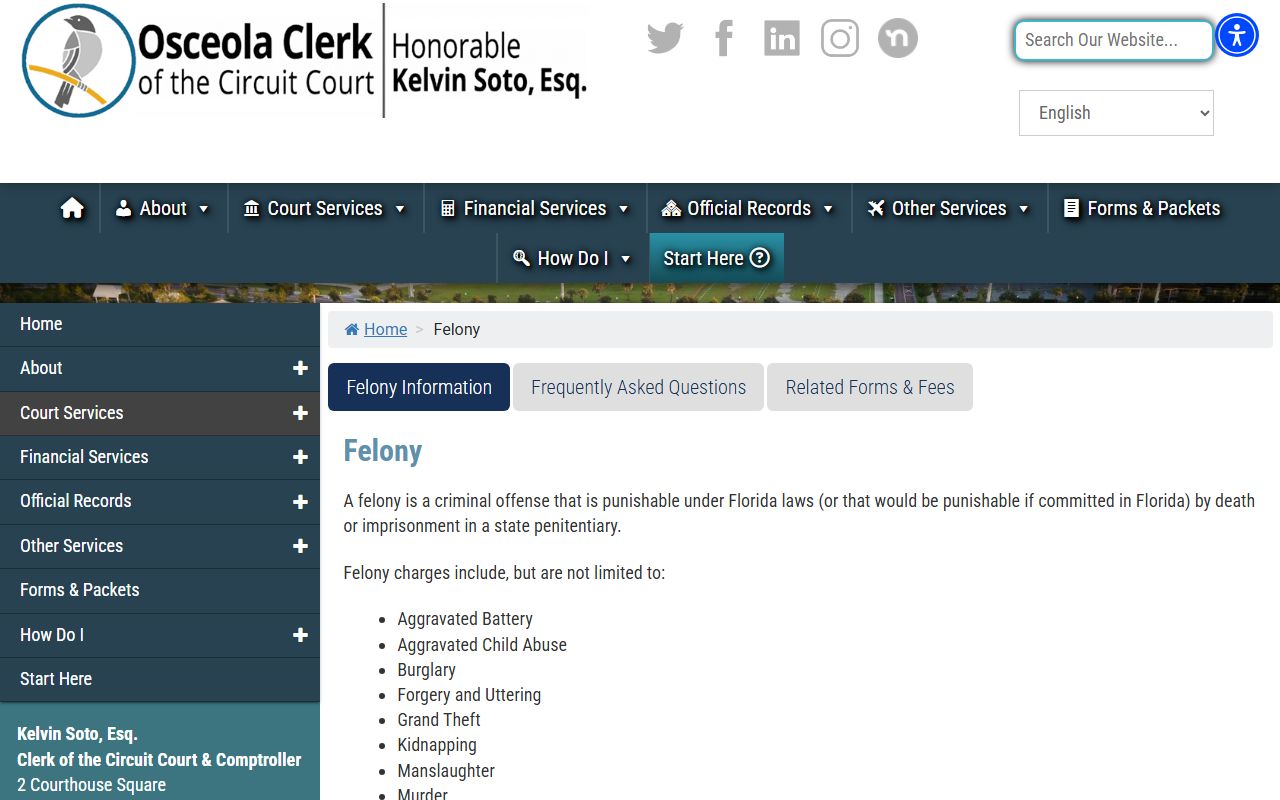
That page is the official source for the arrest-to-charges sequence and explains why a court record can appear days after the booking.
How to Find Osceola County Court Records After an Arrest
Court charges are searched through the Clerk's Benchmark case search. Basic searching is open to the public, though some document images and dockets need registered access under a Florida Supreme Court rule. Start from the inmate detail page, note the name and the Reference number, then run the search.
- Open the Clerk Benchmark court case search.
- Search by case number if the roster Reference looks like one, such as 2014 CF 003321.
- If no case number is known, search by name in Last, First format.
- Open the case and check each charge's code, level, and current status.
For a statewide criminal-history check rather than a single case, the FDLE criminal history service is a separate channel with its own fee. The Clerk's criminal-record request form covers Osceola County cases only.
How Charges Get Filed After an Arrest: Complaint, Information, and Indictment
The charge record begins when a charging document is filed. Booking happens first at the jail, but the formal charge comes from the prosecutor or, for the most serious cases, a grand jury. Florida felony practice usually moves by an information filed by the State Attorney. The three main types are compared below.
| Complaint | Information | Indictment | |
|---|---|---|---|
| Filed By | Officer / Prosecutor | State Attorney | Grand Jury |
| Common For | Misdemeanors | Many felonies | Serious felonies |
| Starts | The case | The case | The case |
Note: formal charges can lag behind booking, so the roster may show a person in custody before the State Attorney's filing appears in the court search.
Charge Status in Court Records After an Arrest
Charges change as a case moves. The State Attorney can add, reduce, amend, or drop a charge, and the booking charges on the jail roster can differ from the charges finally filed. The court record tracks each step. The terms below show up often in a case docket.
| Status | What It Means |
|---|---|
| Pending | The charge is filed and the case is still open before the court. |
| Amended / Reduced | The prosecutor changed the charge, often to a lower level. |
| Dismissed | The charge was dropped and is no longer being pursued. |
| Nolle Prosequi | The State Attorney chose not to prosecute the charge. |
The county does not publish a glossary for every status code, so read a code against the rest of the docket and confirm anything unclear with the Clerk.
Bond and Release After an Arrest
Bond and custody issues are often handled early, at first appearance. In Osceola County, initial appearances are generally held Monday through Friday at 1:30 p.m. and on weekends and holidays at 10:30 a.m. The county does not accept cash for bond; bonds can be paid by card online or posted through a licensed agent. A release can take about four to six hours or longer after a bond or purge is paid. The Bonds and Dockets line is 407-742-4404. A no-bond hold or a detainer can keep a person in custody even after a bond is arranged.
| Bond Type | How It Works |
|---|---|
| Cash / Card Bond | The full amount is paid directly; Osceola takes card online, not cash. |
| Surety Bond | A licensed bail agent posts the bond for a fee. |
| Pretrial Release | Supervised release for eligible defendants, assessed by Community Corrections. |
| No-Bond Hold | Release is not available by ordinary bond until a court acts. |
Note: The county warns that callers posing as the jail may demand bond or release fees through apps like Zelle or Cash App; Corrections never calls to collect payment that way.
Warrants That Lead to an Arrest
An outstanding warrant can result in a booking. A bench warrant, a probation violation, or a failure to appear can all send a person to the county jail. Osceola County has no single public warrant database the way it has an inmate search. The Sheriff's most-wanted page highlights some suspects and lists tip lines, but it is not a full warrant index. A statewide option is the FDLE wanted-person search, which depends on agencies reporting and authorizing public release. A bench warrant can also appear inside a court case file, so the Clerk's case search is a useful second path.
Charges vs. Convictions
Being arrested and charged is not the same as being convicted. A charge is an accusation that opens the case. A conviction is the result of a plea or a verdict. Both are public court records, but they sit at different stages and carry different weight.
| Charge | Conviction | |
|---|---|---|
| Stage | Accusation | Verdict or plea |
| Burden of Proof | Probable cause | Beyond a reasonable doubt |
| Public Record | Yes | Yes |
Sealed vs. Expunged Arrest Records
After a dismissal or an eligible outcome, a person may be able to clear an arrest record. Florida law sets the process through court-ordered sealing and expunction, and a sealed or expunged record should not appear in an ordinary public search. The two are not the same, as the table shows.
| Sealed | Expunged | |
|---|---|---|
| Visibility | Hidden from public view | Treated as if it never existed |
| Law Enforcement | Limited access | Very limited access |
| Eligibility | Set by Florida statute and court order | Set by Florida Statutes 943.0585 and court order |
Court file access and confidentiality follow Florida Statutes 119.0714, while Florida Statutes 943.0585 governs expunction.
Background Check Considerations
A court case search is a casual lookup, not a regulated background check. An employer, landlord, or lender that needs a screening report must use a consumer reporting agency that follows the federal Fair Credit Reporting Act. A public docket and a third-party search tool are not that.
Important: This site is not a consumer reporting agency under the FCRA, and nothing here may be used for hiring, housing, credit, or insurance decisions.
Who Files the Charges After an Arrest
The prosecutor decides the formal charges. Osceola County sits in the Ninth Judicial Circuit, served by the State Attorney's Office along with Orange County. After the jail and the Clerk send the arrest paperwork forward, the State Attorney reviews it and chooses whether to file. That choice is why a court record can differ from the booking charges, and why a person can be in custody before a case shows up in the court search.
The State Attorney's Office does not run a public database of pending cases, citing victim-privacy rules, and it points people to the Clerk's case search for Osceola records. If you need records the prosecutor holds rather than the court file, the office takes a separate public-records request with its own fees. The office is at 2 Courthouse Square, Suite 3500, in Kissimmee, and the main line is 407-742-5200.
Requesting Court Records After an Arrest
When a case is not fully available online, the Clerk takes a criminal-record request, but the rules are specific. The form covers Osceola County cases only, so it will not reach Orange County, statewide FDLE history, or state and federal custody. Payment comes before the search, by cash or money order, and personal checks are not accepted.
The Clerk asks for a record search fee of $2 per year and name, with copies at $1 per page and certification at $2 per document. Requests can be sent by email to recordsrequest@osceolaclerk.org, by fax, or by mail to the Criminal Records Request office at 2 Courthouse Square, Suite 2000, in Kissimmee. Allow 7 to 10 business days, and remember that sealed or expunged records are not disclosed.
Restricted Court Records After an Arrest in Osceola County
Not every record after an arrest is open. Juvenile matters, sealed or expunged cases, and active investigations can be confidential or limited. Florida Statutes 119.071 sets exemptions that can shield investigative and protected information. The Clerk's criminal-record request also will not disclose sealed or expunged records, and registered access may be needed for some electronic images. When a record seems missing, it may be restricted rather than gone.